AI-Enabled Interpretation of Viral Biology at the 1st Pacific One Health Conference
I gave a talk called “AI-Enabled Interpretation of Viral Biology” at the inaugural Pacific One Health Conference, which brought together public health researchers and practitioners from the military, civilian, and private sectors across the Pacific.
The talk was about how our lab uses protein and genome language models to make sense of viral sequence data. Sequencing now produces viral genomes far faster than anyone can annotate them, and most viral proteins still have no assignable function when you rely on traditional homology-based methods. I showed how language models trained on protein sequences can recover functional signal in places where alignment goes quiet, and how extending those models to whole viral genomes lets us treat a virus as a coherent biological system rather than a disconnected list of genes.
For a One Health audience the relevance is fairly direct. The same methods that help us annotate environmental viromes also apply to characterizing pathogens, tracking how they spread, and anticipating phenotype from genotype. Reading viral sequence data faster and more completely strengthens surveillance across human, animal, and environmental health.
I am grateful to the planning team and volunteers who built a venue where those communities could actually talk to each other, and I am looking forward to the collaborations that came out of it.
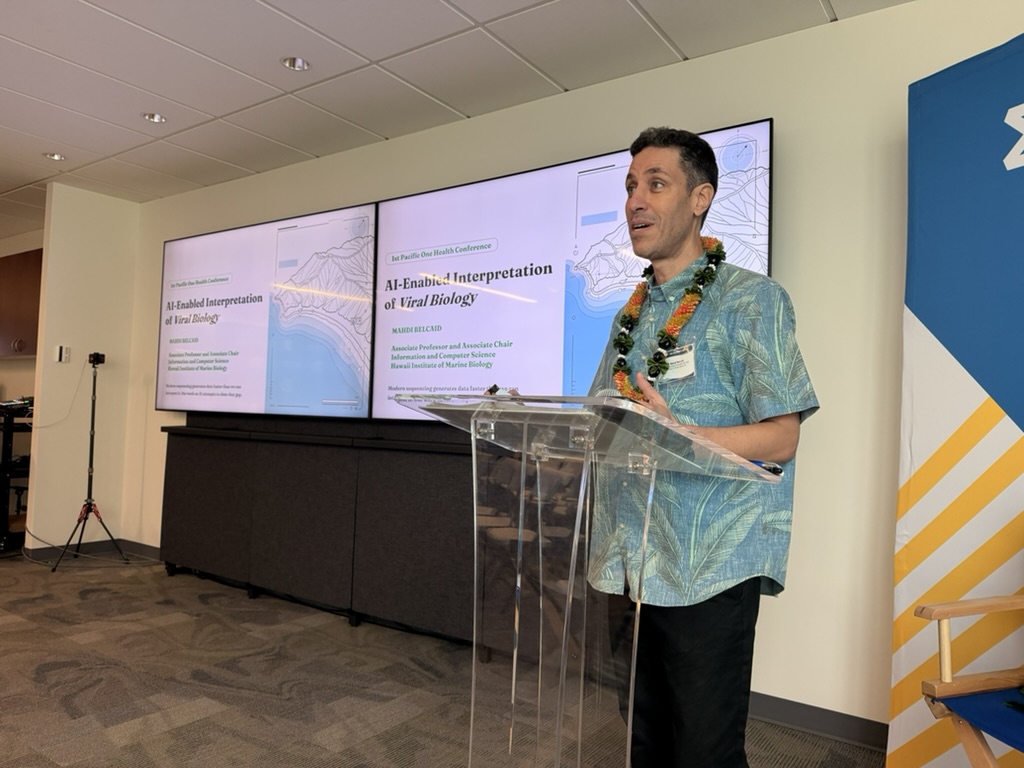
Presenting at the 1st Pacific One Health Conference, Honolulu